Tarjeta de Movilidad Integrada
The card that gets you into the Mexico City Metro and onto almost all of the city’s public transport: what it costs, where to buy it, how to top it up and what happens if you lose it.
What the Movilidad Integrada card is
The Tarjeta de Movilidad Integrada — the “MI card”, as the operator itself calls it — is the contactless stored-value card for public transport in Mexico City. It is a single plastic card with a chip that you hold against the reader on the turnstile: there is no slot to put it in and no magnetic stripe.
What makes it different from a ticket is that it is not just for the Metro. The same card, with the same balance, works on:
- the Metro (all 12 lines)
- Metrobús
- Tren Ligero
- Trolebús
- RTP
- Cablebús
- Ecobici
- the bike parking stations
Each system charges its own fare: the balance is shared, the price is not. A Metro journey costs MX$5 (see fares); the Metrobús, the Tren Ligero and the Cablebús each have their own, published by their own operator.
What it costs and how much it holds
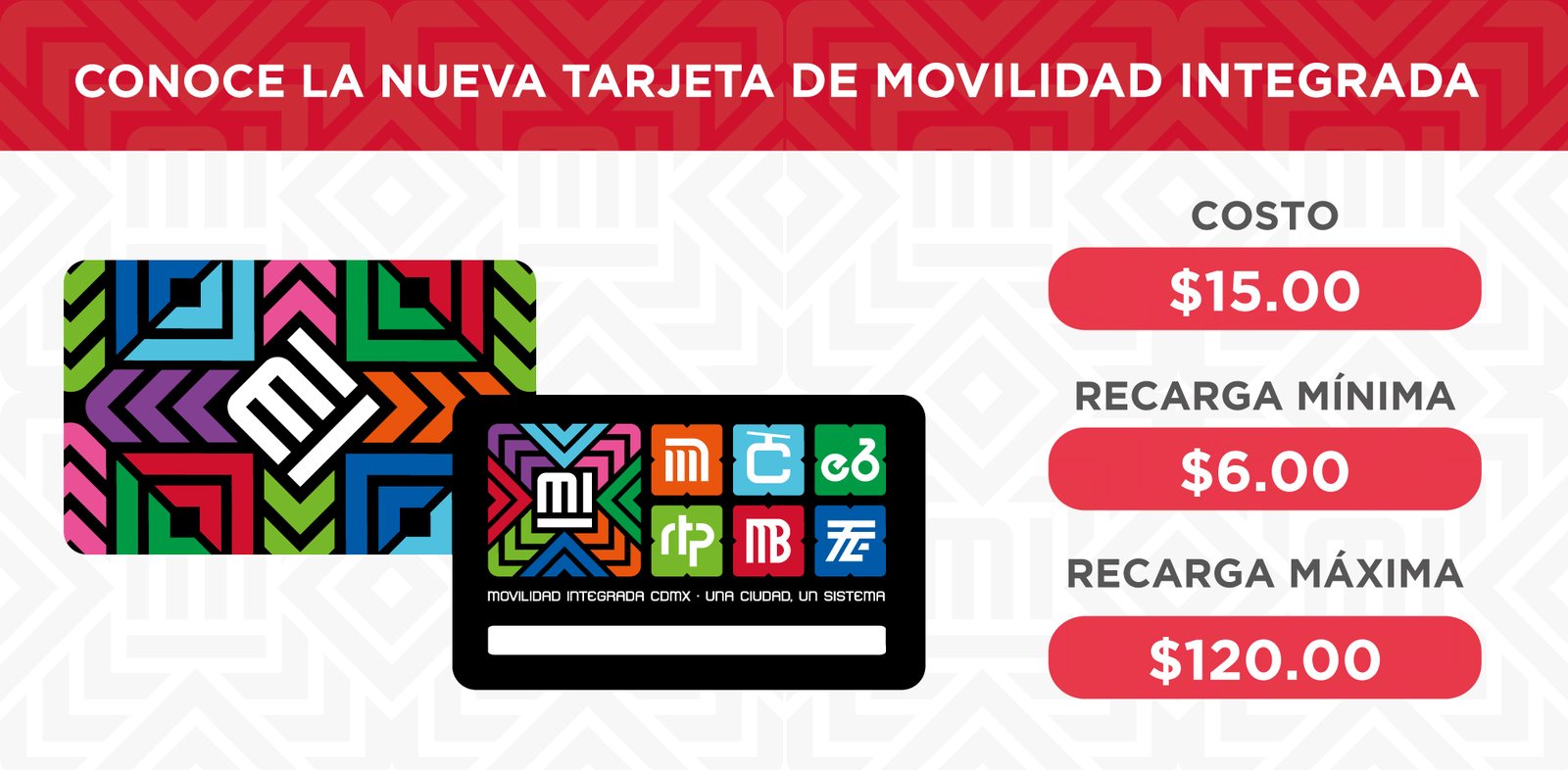
You buy the card once and it stays with you; after that you only top it up. The card is paid for separately from the balance: when you buy it you pay for the card plus whatever you want to load onto it.
| Item | Amount | Source |
|---|---|---|
| Price of the card (balance not included) | MX$15 | The operator's "Tarjeta Recargable" page |
| Maximum balance the card takes | MX$500 | The operator's "Tarjeta Recargable" page |
| How long the balance lasts | 300 calendar days | The Ecobici rules |
| A Metro journey paid with the card | MX$5 | Every station page of the operator's ("Costo del viaje") |
The two figures that matter — the price of the card and the maximum balance — come from the operator’s own “Tarjeta Recargable” page, which says in so many words that the plastic costs 15 pesos and you can load as many journeys onto it as you need, and that the maximum balance is 500 pesos per card. The price has not changed since January 2020, when the MX$5 launch offer ended: the Ecobici rules and the official city guide confirm it too.
The balance expires. The Ecobici rules — it is the same card for every system — say that the balance loaded is valid for 300 calendar days, about ten months. It is the only expiry we have found published, and it sits on the same page that still carries the old maximum balance, so treat it as a guide. What happens to the money once it expires is published by nobody.
How much you can load in one go
Here there is a real gap. The operator’s press release of October 2019 set a minimum top-up of MX$5 and a maximum of MX$99 per transaction; the official slide the Department of Mobility used to present the card, from the same year, gave MX$6 and MX$120. They do not match each other and no source from 2025 or 2026 repeats them. Since the maximum balance of that period has gone out of date, these limits most likely have too, so we do not treat them as current: if you are going to load a large amount, expect the machine to make you do it in several goes.
Does it work out cheaper than a ticket?
No, and it is worth saying plainly: on the Mexico City Metro a journey costs MX$5 however you pay. The MI card gives no discount on the ticket price, there are no 10-journey carnets, no monthly passes, no daily cap and no zonal fares. Nor is there a different price for going further: MX$5 is the whole journey, with as many transfers as you like so long as you do not leave the network.
The advantage of the card is not money, it is convenience: since 2024 there is no paper ticket on any line, so you either carry a card or pay with a contactless bank card. And with a balance on it you skip the line at the ticket window.
Where to buy it and how to top it up
The operator says it on all of its station pages: you can buy the card at any of the 195 stations on the network. In practice, in two places:
- The ticket window in the station.
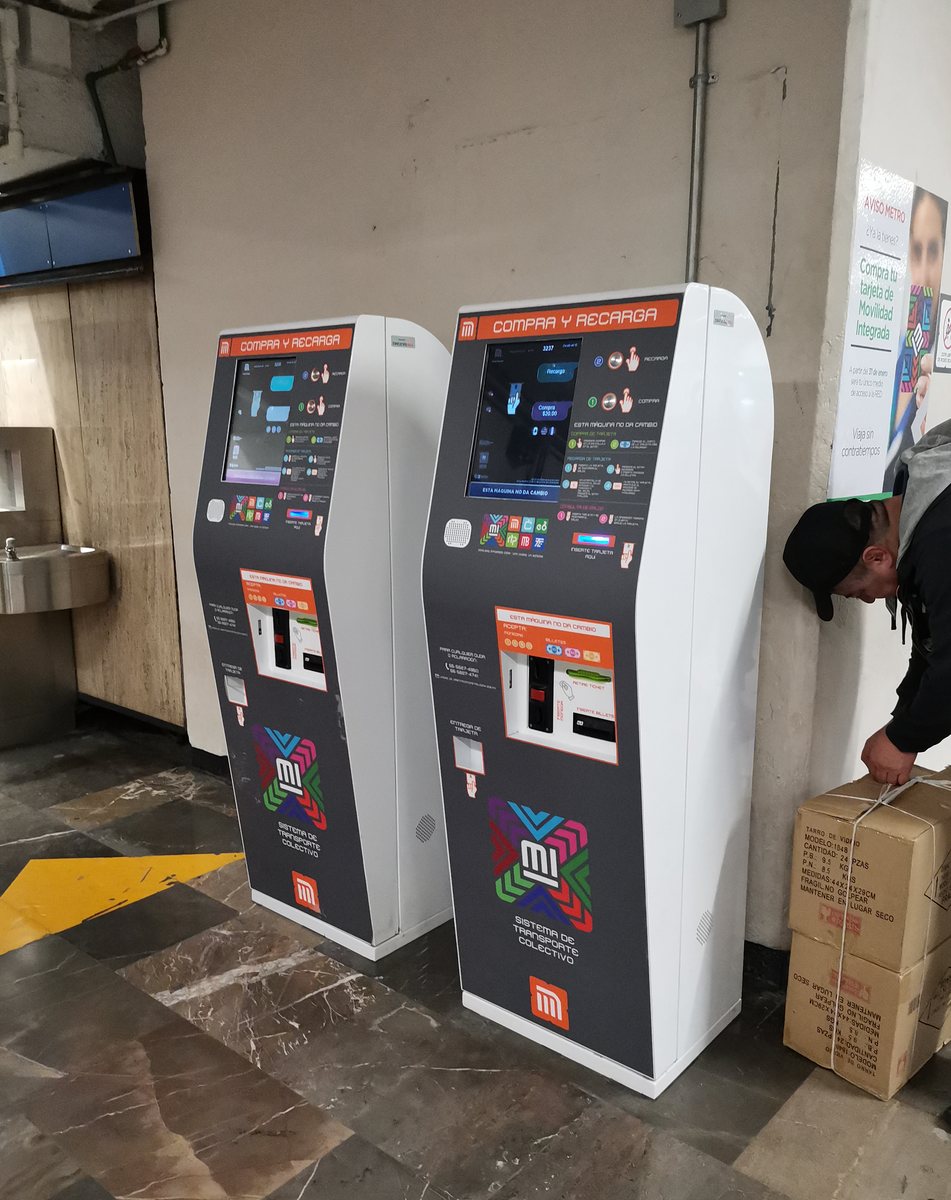
- The buy-and-top-up machines in the ticket halls, which also top up a card you already have. The label on the machine in the photograph says it takes coins and notes and, in large letters, the warning worth not missing: this machine gives no change. Take coins or small notes.
It is the same card for every Movilidad Integrada system, so the one you buy in the Metro works as it is on the Metrobús or the Cablebús, with nothing to arrange.
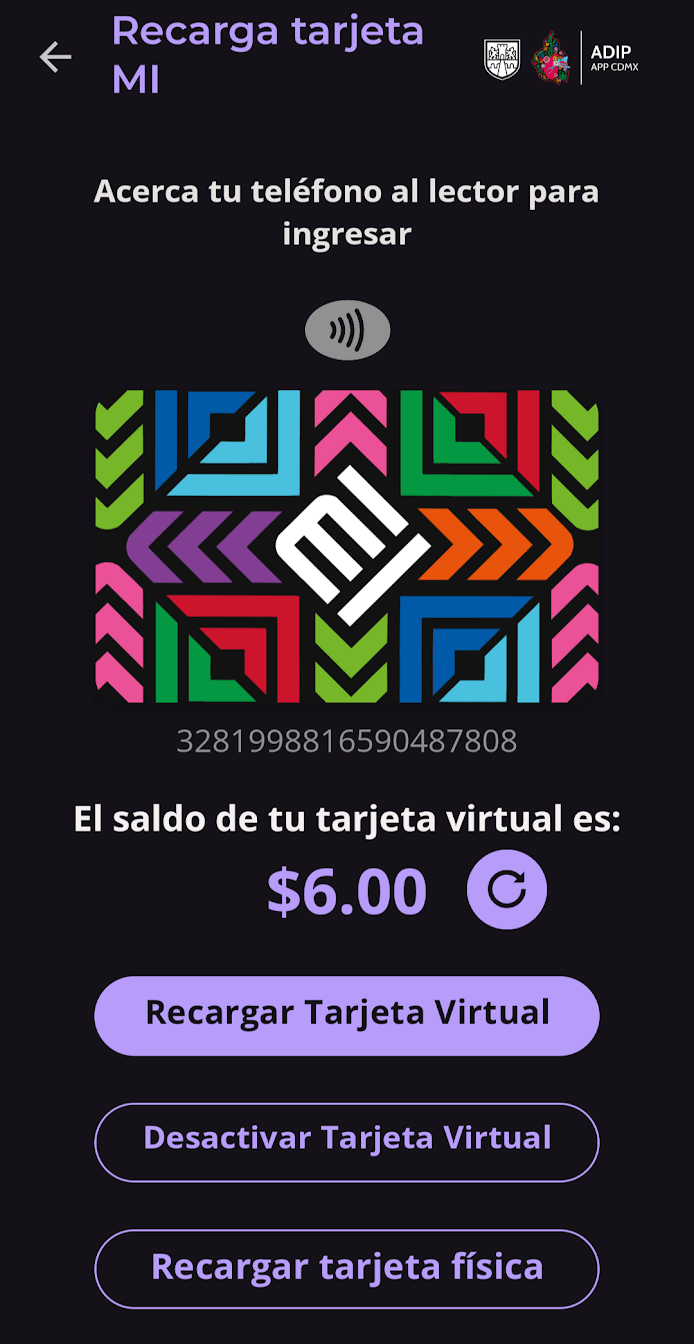
On your phone, the App CDMX — the city government’s official app — has an MI card section with an option to top up the physical card (see the screenshot of the app further down this page). We have found no official website for topping up online, so we do not point you to one.
To check your balance, the operator publishes no list of ways to do it. What is documented is that the machines in the stations top the card up, and that the App CDMX shows the balance of the virtual card. If you have a doubt about your balance, the ticket window is the only point of contact the operator publishes.
The digital card and paying with a bank card
There are three ways into the Metro today, and only one of them needs the piece of plastic:
1. The physical MI card. The usual one, bought at the ticket window.
2. The digital MI card, inside the App CDMX. This is the new one: the city’s digital agency launched it on December 10, 2025, with version 4 of the App CDMX. Its words: a virtual version of the MI card has been enabled, and it can be topped up directly from the app using CoDi or credit and debit cards. For now it is available only on Android and Huawei. If you use an iPhone, you do not have it yet.
The same app also has a section for topping up the physical card, which according to the agency covers the Mexicable, the Mexibús, the Tren Interurbano México-Toluca, the Metro, the Metrobús, the Cablebús, the Trolebús and the Tren Ligero.
In the screenshot of the app beside this text, from December 2025, the top-up screen shows the card number, the balance and the instruction to hold your phone against the reader to get in, with buttons to top up the virtual card, turn it off and top up the physical one. In other words: the phone acts as the card. That part comes from the screenshot, not from the bulletin: the agency published no technical sheet, so we cannot confirm whether NFC is required, or which systems accept the virtual card.
3. Your own contactless bank card. Since September 2024 the operator has accepted contactless Mastercard, Visa and American Express cards straight at the turnstiles, and since October 16 of that year across the whole network, Line 12 included. Phone wallets and smartwatches work too. It charges the same MX$5 a journey. There is nothing to buy and nothing to register: you tap and go.
Operator press releases 66/24 (September 27, 2024) and 73/24 (October 16, 2024); city digital agency bulletin of December 10, 2025.
What happened to the paper ticket
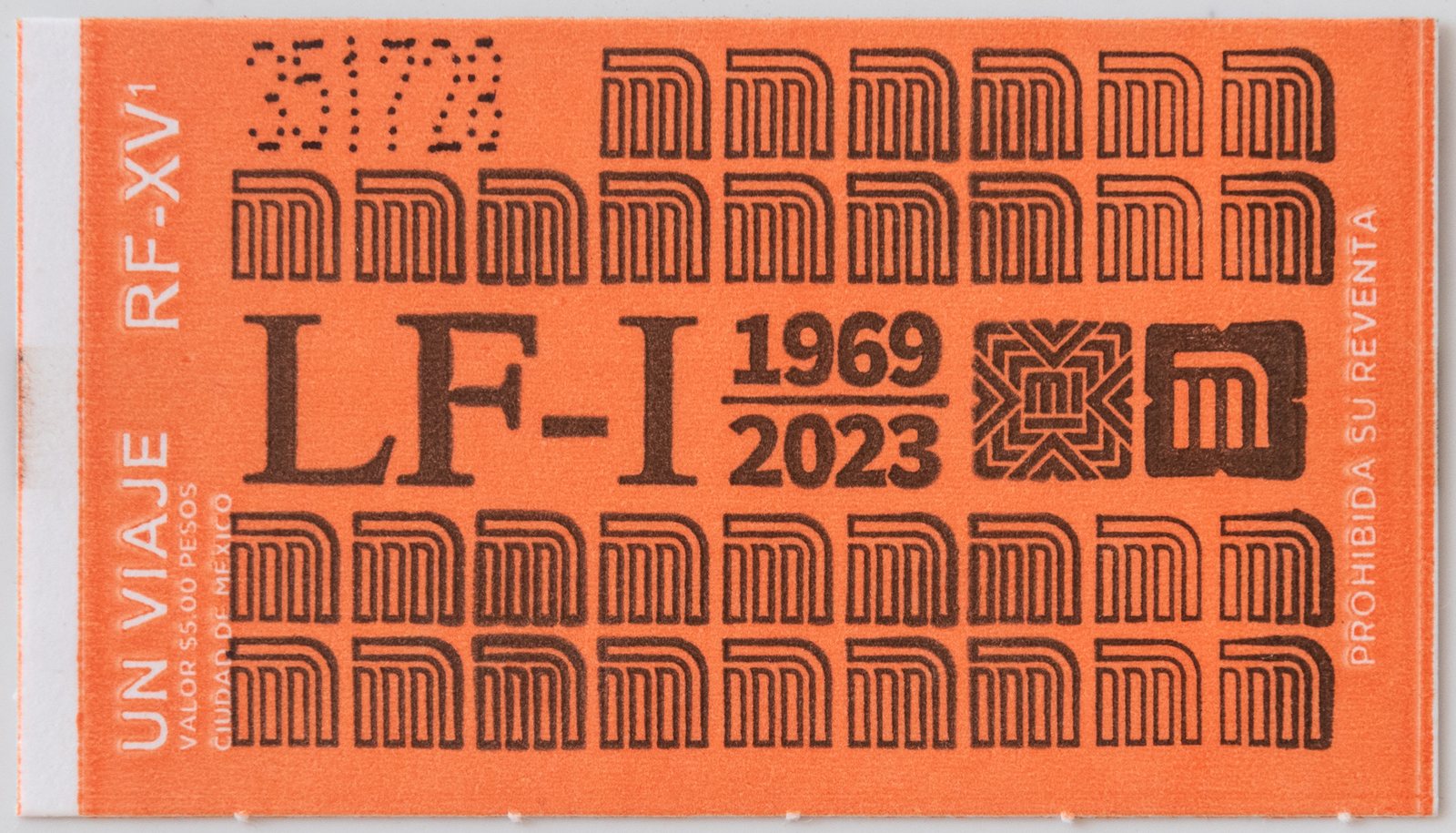
It no longer exists. The card magnetic ticket, in use since the Metro opened in September 1969, stopped getting anyone into the network on Saturday, April 20, 2024. The last day you could get in with a ticket was Friday, April 19, 2024, and only on Lines 2 and 3, the last two on the network.
The operator withdrew it line by line: Line 12 was born without tickets in 2012; in September 2023 Lines 4, 6 and 7 followed, in October Line 5 and the rebuilt Line 1, on November 25 Lines 9 and B, in December Lines 8 and A, and Lines 2 and 3 closed the list. Its press release 38/24, of April 17, 2024, gives the date: Friday April 19 will be the last day on which passengers may enter with magnetic tickets, which will no longer be sold at the ticket windows. From Saturday the 20th, entry to the 24 stations of Line 2 and the 21 stations of Line 3 will be exclusively with the Movilidad Integrada (MI) card, as in the rest of the network. The last print run came to 14 million tickets.
There is a caveat about the day, and it is worth knowing because two dates circulate: two days earlier, press release 34/24 gave Saturday the 20th as the last day with a ticket and Sunday the 21st as the first card-only day. Release 38/24 brought it forward by a day and the operator corrected the headline on its own site, so the date to trust is the one in 38/24 — the press of the 20th confirms it. And if you have read “March 1, 2024” in the official city guide, that is the date that was announced and not the one that happened: on January 26, 2024 the operator was still selling tickets for Lines 2 and 3.
Operator press releases 13/24 (January 26, 2024), 101/23 (November 13, 2023), 34/24 (April 15, 2024) and 38/24 (April 17, 2024).
Who does not have to pay
On every station page the operator publishes the short list: “Older passengers, disabled passengers, children under 5, young people with an INJUVE card and uniformed police officers”. Its own application page for free travel is more precise, and adds what you actually need to know:
- Passengers over 60, with an INAPAM or INSEN card or a voter ID
- Disabled passengers, on production of official ID
- Children under 5 with an adult — the adult does pay
- Young people with an INJUVE card
- Uniformed police officers
- Members of citizens' committees and councils, with an electoral institute card and only at election time
The operator’s “Acceso de cortesía para” page. Applying is free of charge.
It is not a small number: in 2024 the operator recorded 149,996,606 free entries out of a total of 1,171,859,113, which is one journey in eight.
Watch the age, because it is not the same across the city: on the Metro free travel starts at 60, but the Metrobús applies it from 70, does not extend it to companions and, on its Line 4 to the airport, recognises it only for disabled passengers and children under 5.
There is also a card of its own for people with a permanent disability, the Tarjeta de Gratuidad, or Tarjeta Incluyente, which the Department of Mobility issues free of charge and which does have published rules: valid for a maximum of five years, blocked if theft or loss is reported, and replaceable up to three times a year. And a “Libre Acceso” card, which the operator cites as the one that lets you use the station elevators; its application process has not reopened in years (renewals only).
The MX$3 fare is suspended
There was a reduced MX$3 fare for students, single mothers and unemployed people. It still exists on the operator’s books, but its application page says so without ceremony: this procedure is suspended until further notice, and first-time issue of the reduced-fare card has ended. In other words: no new cards are being issued. We have found no later notice reopening it or abolishing it.
If it breaks, if you lose it, or if you want your money back
A damaged card: the balance can be saved
This is the good news, and it is the only procedure the operator publishes. If your card is physically damaged but you still have it, you can move its balance to another one: go to a Tarjeta Recargable desk with the damaged card and a card in good condition, for the balance to be transferred. The operator itself asks you not to leave it: for any question or query about the card and its transactions, come within 3 months.
| Tarjeta Recargable desk | Line | Hours |
|---|---|---|
| BalderasES | L1 | Mon-Fri 08:00-19:50 |
| Zócalo/Tenochtitlan | L2 | Mon-Fri 09:10-15:50 |
| Hidalgo | L3 | Mon-Fri 08:10-19:50 |
| Juárez (annex building) | L3 | Mon-Fri 08:10-19:50 |
| Centro MédicoES | L9 | Mon-Fri 08:10-19:50 |
| ErmitaES | L12 | Mon-Fri 09:10-15:50 |
Tarjeta Recargable desks as listed on the operator’s application page. Contact: [email protected] · 55-5627-4588 ext. 5128.
One rule worth knowing: you do this where you bought the card. If you bought it in the Metro, at these desks; if you bought it on the Metrobús, the Tren Ligero or Ecobici, at that system’s own customer desks.
And to keep it from coming to that, the operator publishes instructions on looking after it: To make your Movilidad Integrada card last, do not mistreat it, bend it, punch holes in it, laminate it, scratch it, get it wet or leave it in the heat
A lost or stolen card: there is no published procedure
Here we have to tell you there is no answer. We have looked through the application pages and FAQs of the operator, the Metrobús, the Tren Ligero, RTP and Ecobici, through the Movilidad Integrada material and through the city’s official gazette, and there is no published procedure for replacing a lost MI card, blocking it or recovering its balance.
Not published does not mean it does not exist, so we are not going to claim the money is gone. What we can tell you is that we have not found a single official route to get it back, and that this is reason enough not to load the card with too much: it takes up to MX$500, but a few journeys’ worth is plenty. That advice is ours, not the operator’s.
The contrast is telling: the Tarjeta de Gratuidad (the Tarjeta Incluyente for disabled passengers) does have rules published in the official gazette — you report the theft or loss, the card is invalidated and it can be replaced up to three times a year. The ordinary MI card does not.
Expired balance, and balance loaded off the network
The balance has a published validity of 300 calendar days; what happens once that runs out is not published. What the operator does say is that a balance loaded outside the official sales and top-up network is cancelled and cannot be recovered: top up only at ticket windows, machines or in the App CDMX.
We are not going to invent a replacement procedure that appears in no document. If the operator or the Department of Mobility publishes one, we will put it here with its date.
Frequently asked questions
What we could not confirm
The price, the maximum balance, the withdrawal of the ticket, the digital card and the free-travel rules on this page are all checked against official sources, each with its date. This is what, having looked for it, we did not find published:
- The minimum and maximum top-up per transaction. The only figures are from 2019, they do not match each other and no recent source repeats them.
- When the maximum balance went up from MX$120 to MX$500. The announcement exists, but the server that hosts it does not answer us and the Internet Archive has no copy of that page.
- What happens if you lose the card or it is stolen, and whether an expired balance can be recovered.
- The list of official ways to check your balance.
- Whether the MX$3 fare will come back: the scheme has been suspended “until further notice” since 2024 and no further notice has come.
- Whether the virtual card needs NFC, and which systems accept it: the agency’s bulletin does not say.
One more warning, in case you compare with other sites: there are official pages of the city’s own that are out of date. The Ecobici rules still carry the MX$120 maximum balance, and the official city guide dates the withdrawal of the ticket to March 1, 2024 — the date that was announced, not the real one — and still mentions paper tickets. When two official sources clash, this page goes with the operator, which issues the card and runs the Metro.
The operator’s site does not answer from our servers, so we read it in the archived copies of the Internet Archive. If you have a document that settles any of these gaps, tell us and we will add it with its source.
More on how this guide is made and what sources it uses on the about page.