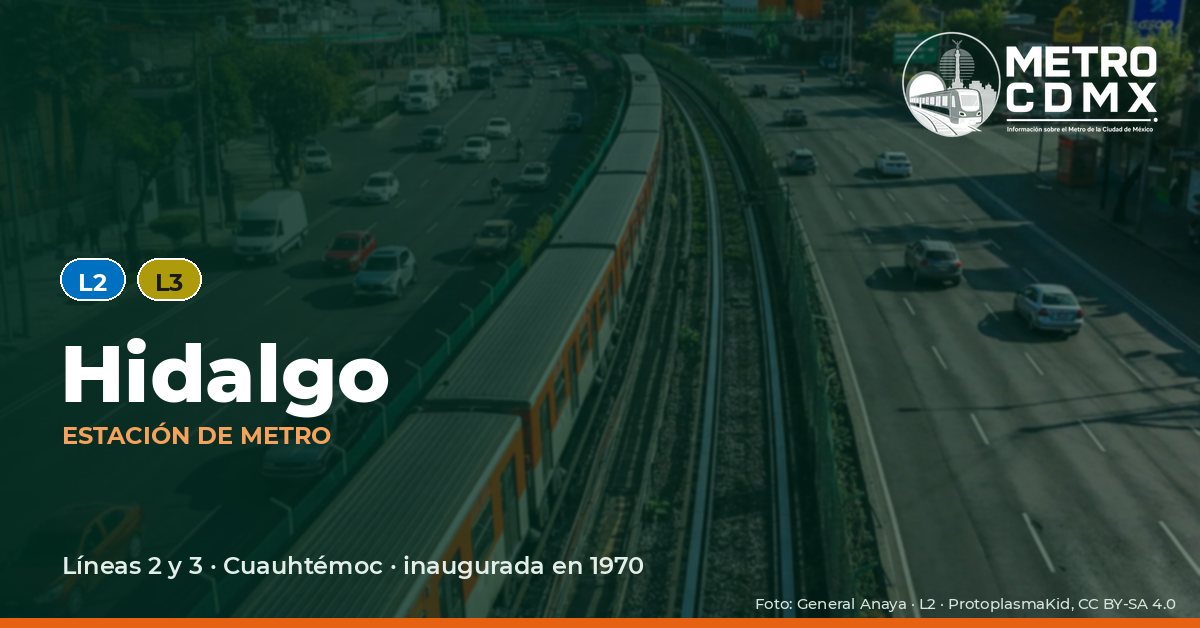
Hidalgo metro station
Line 2 and Line 3 · Borough Cuauhtémoc
Hidalgo station
Hidalgo has been an interchange since 1970: Line 2 arrived on September 14 and Line 3 on November 20 of that year. Both are underground, in Cuauhtémoc, beneath the crossing of Reforma and Avenida Hidalgo. On Line 2 it sits between Revolución and Bellas Artes; on Line 3, between Guerrero and Juárez. In 2024 it came to 15.3 million entries: 10.9 on Line 2 and 4.4 on Line 3.
The name honours Miguel Hidalgo y Costilla. According to the operator he was born in Guanajuato on May 8, 1753, studied in Morelia and at the Colegio de San Nicolás, where he graduated in philosophy and was ordained a priest. On September 15, 1810, with his men in the forecourt of the church of Dolores, he rang the bells and set the independence movement in motion; he was shot on July 30, 1811 and his remains are in the Columna de la Independencia. Inside the station there are two cultural display cases and, on Line 3, a public prosecutor’s office.
Service hours at Hidalgo
| Day | Network service hours |
|---|---|
| Monday to Friday | 5:00 to 24:00 |
| Saturday | 6:00 to 24:00 |
| Sundays and public holidays | 7:00 to 24:00 |
These are the service hours the operator publishes for the whole network, the same at every station. It does not publish a first and last train time for each station: a train leaving a terminus at opening time takes a few minutes to reach the others, and service can change on special days.
How often trains run (estimate)
An estimate: it is the single headway the SEMOVI GTFS models for the whole line and the whole day (open data, valid until December 31, 2025). The operator does not publish headways by time of day; at peak and off-peak times the real interval changes.
Stations next to Hidalgo
Approximate travel time between Hidalgo and the stations either side of it.
| Line | Next station | Estimated time |
|---|---|---|
| L2 | Revolución | 1.4 min |
| L2 | Bellas Artes | 1.1 min |
| L3 | GuerreroES | 1.5 min |
| L3 | Juárez | 0.8 min |
Running time as modeled in the SEMOVI GTFS (open data, valid until December 31, 2025), not counting the wait or the time standing at the station. It is not a timetable figure from the operator.
Transfers and connections
- Metro: interchange between Line 2 and Line 3, inside the same station (the operator treats it as one station, with passageways between the platforms; it does not publish transfer times).
- Metrobús: Metrobús Line 3 Hidalgo, in Avenida Balderas, level with the Callejón Colón. Metrobús Line 4 Hidalgo, in Avenida Hidalgo, level with the Av. Paseo de la Reforma.
- Trolebús: Line LL (San Felipe de Jesús – Metro Hidalgo) running east to west and back, on Paseo de la Reforma.
Transfers to other systems as listed on the station page the operator publishes. The Metrobús, Trolebús, Tren Ligero and Tren Suburbano are paid for separately.
Accessibility
Escalators.
Station page, "Instalación para personas con discapacidad" section — the operator's own words
Services in the station
- Public prosecutor's office
Inside Hidalgo station on Line 3, at Avenida Hidalgo and Paseo de la Reforma, colonia Centro, Cuauhtémoc, open from 9:00 to 19:00, Monday to Friday; its staff also work Saturdays, Sundays and public holidays from 9:00 to 21:00, at Calle Gral. Gabriel Hernández No. 56, colonia Doctores (Búnker PGJ), 3rd floor. - Women's help desk (Viaja Segura program)
In support of the “Viaja Segura programme on Mexico City public transport”, the Metro provided the space for the desk inside the public prosecutor's office, by the stairs out to Eje 1 Sur Guerrero. Open Monday to Friday from 08:00 to 20:00. - Information desk
On the Line 2 transfer passageway. Open Monday to Friday from 9:00 to 16:00. - Cultural display case
Two display cases, near the station's internet centre, towards Indios Verdes.
From the station page the operator publishes; opening times and locations can change.
Exits at Hidalgo
The station exits and where they come out, as the operator describes them.
| Exit | Location |
|---|---|
| From Line 2, south | Reforma corner of Dr. Basilio Vadillo, Colonia Tabacalera. |
| From Line 2, north | Avenida Hidalgo corner of Héroes (Iglesia San Hipólito), Colonia Tabacalera. |
| From Line 2, south-east | Calle Balderas corner of Paseo de la Reforma (Cinemas Cine México), Colonia Tabacalera. |
| From Line 2, south | Eje de Guerrero, Colonia Guerrero. |
| From Line 2, north | Eje de Guerrero, Colonia Guerrero. |
| From Line 3, south-east | Avenida Hidalgo and Calle Balderas, Colonia Centro. |
| From Line 3, north-east | Reforma and Avenida Hidalgo, Colonia Centro. |
| From Line 3, East | Avenida Hidalgo and Alameda Central, Colonia Centro. |
The Hidalgo icon
Every station on the Metro has an icon of its own. This is how the operator describes it:
The station icon is a bust of the great hero of Mexican independence. Miguel Hidalgo y Costilla was born in Guanajuato on May 8, 1753. He studied in Morelia and later entered the Colegio de San Nicolás in Mexico City, where he graduated in philosophy and was ordained a priest. Hidalgo began Mexican independence. On September 15, 1810 he and his men reached the forecourt of the church of Dolores, where they rang the bells and set the independence movement in motion. On July 30, 1811 father Miguel Hidalgo y Costilla was shot for rising against the Spanish. His remains lie in the Columna de la Independencia. NEARBY: the Centro Cultural José Martí, the church of San Hipólito and the San Fernando cemetery.
Official description of the icon — the operator's own words
The Metro icons are registered with INDAUTOR by their owner, which is why we do not reproduce them.
What's near Hidalgo
The exits are spread between colonia Tabacalera (Reforma and Basilio Vadillo, Avenida Hidalgo beside the church of San Hipólito, Balderas and Reforma), colonia Guerrero and colonia Centro, opposite the Alameda. The operator lists as places of interest the Centro Cultural José Martí, San Hipólito and the San Fernando cemetery. Within 150 m you have the Museo del Pulque y las Pulquerías, the Plaza Francisco Zarco, the Laboratorio Arte Alameda and the Museo Kaluz; about 210 m away, the Museo Panteón de San Fernando. Metrobús lines 3 and 4 and Trolebús line LL stop here.
| Place | Straight-line distance | On foot (estimate) |
|---|---|---|
| Museo del Pulque y las Pulquerías | 40 m | 1 min |
| Iglesia de San Hipólito | 70 m | 1 min |
| Monumento Vicente Guerrero | 210 m | 3 min |
| Plaza de la Solidaridad | 210 m | 3 min |
| Museo Panteón de San Fernando | 210 m | 3 min |
| Templo de San Fernando | 270 m | 4 min |
| Templo de San Juan de Dios | 370 m | 6 min |
| Museo Franz Mayer | 380 m | 6 min |
Places from OpenStreetMap within 400 m. The walking time is an estimate (straight-line distance × 1.3).