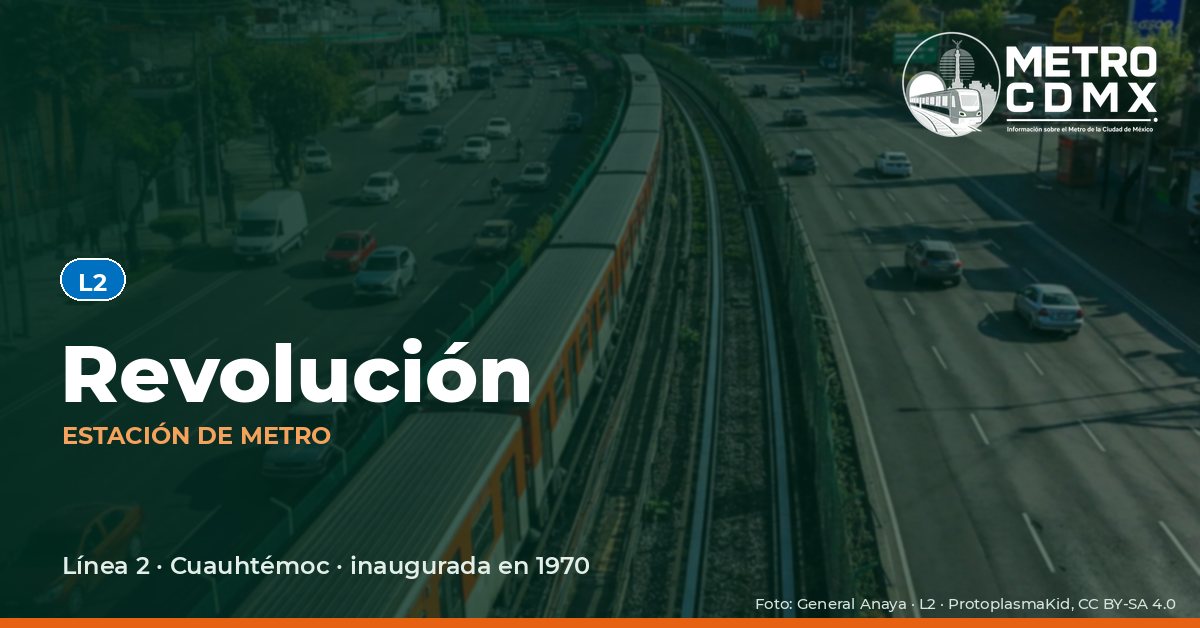
Revolución metro station
Line 2 · Borough Cuauhtémoc
Revolución station
Revolución opened on September 14, 1970 on Line 2, an underground station beneath Puente de Alvarado, between San CosmeES and Hidalgo. It takes its name from the monument nearby, and the operator gives over the description of its icon to telling how that was built: the building was conceived in French Renaissance style by Émile Bernard, to house the Porfirian legislative palace; construction began on September 23, 1910 and was abandoned in 1912, with only the dome standing firm.
According to that same text, in 1932 the architect Carlos Obregón Santacilia proposed using the structure for a monument to the Revolution, finished in 1938, with four sculptural groups by Oliverio Martínez representing independence, the Reform Laws, the labour laws and the land laws. Its bronze urns hold the remains of Venustiano Carranza, Francisco I. Madero, Plutarco E. Calles and Lázaro Cárdenas. According to the operator the icon is the silhouette of the monument. In 2024 the station recorded 9.4 million entries.
Service hours at Revolución
| Day | Network service hours |
|---|---|
| Monday to Friday | 5:00 to 24:00 |
| Saturday | 6:00 to 24:00 |
| Sundays and public holidays | 7:00 to 24:00 |
These are the service hours the operator publishes for the whole network, the same at every station. It does not publish a first and last train time for each station: a train leaving a terminus at opening time takes a few minutes to reach the others, and service can change on special days.
How often trains run (estimate)
| Line | Monday to Friday | Saturday | Sundays and public holidays |
|---|---|---|---|
| L2 | every 3 min | every 3 min | every 3 min |
An estimate: it is the single headway the SEMOVI GTFS models for the whole line and the whole day (open data, valid until December 31, 2025). The operator does not publish headways by time of day; at peak and off-peak times the real interval changes.
Stations next to Revolución
Approximate travel time between Revolución and the stations either side of it.
| Line | Next station | Estimated time |
|---|---|---|
| L2 | San CosmeES | 1.4 min |
| L2 | Hidalgo | 1.4 min |
Running time as modeled in the SEMOVI GTFS (open data, valid until December 31, 2025), not counting the wait or the time standing at the station. It is not a timetable figure from the operator.
Transfers and connections
- Metrobús: Metrobús Line 1, station Revolución, in Puente de Alvarado and Avenida Insurgentes Norte. Metrobús Line 4, station Puente de Alvarado, in Avenida Puente de Alvarado and Calle Ponciano Arriaga.
Transfers to other systems as listed on the station page the operator publishes. The Metrobús, Trolebús, Tren Ligero and Tren Suburbano are paid for separately.
Accessibility
Access ramps, a tactile guide strip, braille plates and escalators.
Station page, "Instalación para personas con discapacidad" section — the operator's own words
Exits at Revolución
The station exits and where they come out, as the operator describes them.
| Exit | Location |
|---|---|
| south | Calle Puente de Alvarado, Colonia Tabacalera. |
| north-east | Calle Puente de Alvarado at the corner of B. de Sahaún, Colonia Buenavista. |
| north-west | Calle Puente de Alvarado, Colonia Buenavista. |
The Revolución icon
Every station on the Metro has an icon of its own. This is how the operator describes it:
The station icon is the silhouette of the Monument to the Mexican Revolution. The monument was originally conceived in a classical French Renaissance style by the architect Emile Bernard, to house the legislative palace in the Porfirian era. Building began on September 23, 1910 and the structure was abandoned in 1912, with only the dome standing firm. In 1932 the architect Carlos Obregón Santacilia proposed to the government that the structure be used to build a monument to the Revolution; the plan was approved, and with sketches, projects and designs the building went on until it was finished in 1938. The original structure of the dome was used, and at its top, 63 metres up, were set the four sculptural groups representing independence, the Reform Laws, the labour laws and the land laws, by the sculptor Oliverio Martínez. The work is in chiluca, a volcanic stone. The remains of Venustiano Carranza, Francisco I. Madero, Plutarco E. Calles and Lázaro Cárdenas were later placed there in bronze urns.
Official description of the icon — the operator's own words
The Metro icons are registered with INDAUTOR by their owner, which is why we do not reproduce them.
What's near Revolución
The exits come out on Puente de Alvarado, in colonias Tabacalera and Buenavista. About 340 m away are the Monumento a la Revolución and the Museo Nacional de la Revolución; about 260 m, the Museo Nacional de San Carlos, and about 220 m, the statue of Columbus. The Museo Universitario del Chopo is about 400 m away. In the area you can connect with Metrobús lines 1 and 4.
| Place | Straight-line distance | On foot (estimate) |
|---|---|---|
| Monumento a Colón (estatua) | 220 m | 4 min |
| Museo Nacional de San Carlos | 260 m | 4 min |
| Monumento a la Revolución | 340 m | 6 min |
| Museo Nacional de la Revolución | 340 m | 6 min |
| Museo Universitario del Chopo | 400 m | 6 min |
| Terminal Metro Revolucion | 110 m | 2 min |
| Hospital Azura Centro | 120 m | 2 min |
| Tianguis Ezequiel Montes | 160 m | 3 min |
Places from OpenStreetMap within 400 m. The walking time is an estimate (straight-line distance × 1.3).
Frequently asked questions
According to the operator, the remains of Venustiano Carranza, Francisco I. Madero, Plutarco E. Calles and Lázaro Cárdenas were placed in bronze urns in the monument. It is about 340 m from the station.
According to the operator, to be the legislative palace of the Porfirian era, designed by Émile Bernard. Work began in 1910 and was abandoned in 1912; in 1932 Carlos Obregón Santacilia proposed turning the dome into the monument we see today, finished in 1938.