
La Villa/Basílica metro station
Line 6 · Borough Gustavo A. Madero
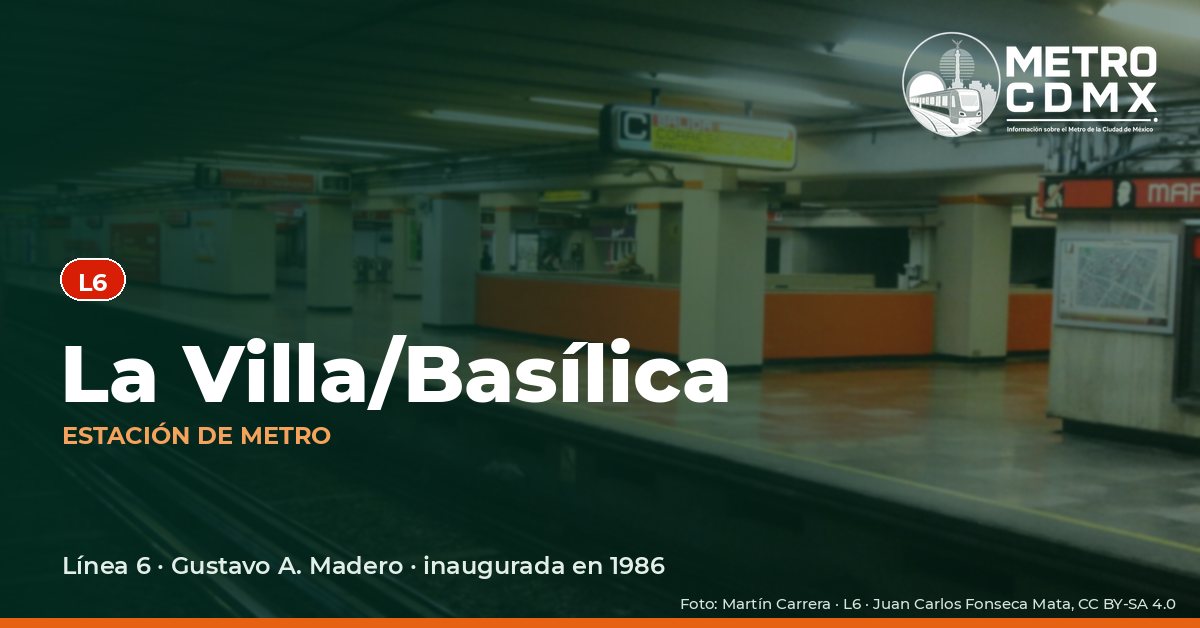
La Villa/Basílica station
The station opened on July 8, 1986 with Line 6 under the name La Villa, and in 1996 became La Villa/Basílica, a name that adds the direct reference to the sanctuary. It is underground, in Gustavo A. Madero, and sits between Deportivo 18 de MarzoES and Martín CarreraES. In 2024 it recorded 3.8 million entries.
According to the operator, the station’s image is the silhouette of the Virgin of Guadalupe and the basilica. The operator tells the story of the place: the teocalli of Tonantzin at the old Pepeaquilla, the apparitions to Juan Diego from the 9th to the 12th of December 1531, the first basilica built between 1695 and 1709 by the architect Pedro de Arrieta, and the present one, designed by Pedro Ramírez Vázquez, which holds 12 thousand people inside and 30 thousand in the forecourt.
Service hours at La Villa/Basílica
| Day | Network service hours |
|---|---|
| Monday to Friday | 5:00 to 24:00 |
| Saturday | 6:00 to 24:00 |
| Sundays and public holidays | 7:00 to 24:00 |
These are the service hours the operator publishes for the whole network, the same at every station. It does not publish a first and last train time for each station: a train leaving a terminus at opening time takes a few minutes to reach the others, and service can change on special days.
How often trains run (estimate)
| Line | Monday to Friday | Saturday | Sundays and public holidays |
|---|---|---|---|
| L6 | every 4 min | every 4 min | every 4 min |
An estimate: it is the single headway the SEMOVI GTFS models for the whole line and the whole day (open data, valid until December 31, 2025). The operator does not publish headways by time of day; at peak and off-peak times the real interval changes.
Stations next to La Villa/Basílica
Approximate travel time between La Villa/Basílica and the stations either side of it.
| Line | Next station | Estimated time |
|---|---|---|
| L6 | Deportivo 18 de MarzoES | 1.2 min |
| L6 | Martín CarreraES | 1.9 min |
Running time as modeled in the SEMOVI GTFS (open data, valid until December 31, 2025), not counting the wait or the time standing at the station. It is not a timetable figure from the operator.
Transfers and connections
- Trolebús: Line LL (San Felipe de Jesús – Metro Hidalgo) running east to west and back, on Calzada de Guadalupe.
Transfers to other systems as listed on the station page the operator publishes. The Metrobús, Trolebús, Tren Ligero and Tren Suburbano are paid for separately.
Accessibility
The station page the operator publishes has no section on facilities for disabled passengers. That does not mean there are none: there is no published information.
Services in the station
- Internet center
Through the east entrance, Monday to Friday from 8:00 to 20:00. The service is free; to use it, please show original, valid official identification. - Cultural display case
Just past the platform, towards El Rosario.
From the station page the operator publishes; opening times and locations can change.
Exits at La Villa/Basílica
The station exits and where they come out, as the operator describes them.
| Exit | Location |
|---|---|
| West | Calle Ricarte and Calzada de Guadalupe, Colonia Aragón. |
| East | Alberto Herrera and Calzada de Guadalupe, Colonia La Villa. |
The La Villa/Basílica icon
Every station on the Metro has an icon of its own. This is how the operator describes it:
The station image is the silhouette of the Virgin of Guadalupe and the basilica. Before the conquest there was a place near Tenochtitlan called Pepeaquilla, with a teocalli — an indigenous temple — where the ancient Mexica worshipped Tonantzin, the mother of the gods. Years later the teocalli was destroyed, and the image of the goddess with it; the story goes that in the early sixteenth century the Virgin of Guadalupe appeared there to an indigenous man named Juan Diego. This happened from the 9th to the 12th of December 1531, exactly 10 years after the conquest was completed. Basilica is the name given to the church that has held, for 400 years, Juan Diego's cloak with the image of the Virgin on it. The first basilica was built between 1695 and 1709 by the architect Pedro de Arrieta; from 1802 to 1836 the architect and sculptor Manuel Tolsá built a second altar, and for the papal coronation of the Virgin of Guadalupe in 1895 the altar we can still see today was built by the sculptor Carlo Nicoli, in Carrara marble. It is known as the old basilica. The present basilica was designed by the architect Pedro Ramírez Vázquez; it draws the largest attendance in the world, with mass said 365 days a year and occasions when more than 100 thousand people come. It is designed for 12 thousand people inside and 30 thousand in the vast forecourt.
Official description of the icon — the operator's own words
The Metro icons are registered with INDAUTOR by their owner, which is why we do not reproduce them.
What's near La Villa/Basílica
The Basílica de Santa María de Guadalupe is about 350 m from the station. On the way you pass the Mercado La Villa (about 220 m), the Pasaje Guadalupano (about 230 m) and the Museo de Figuras de Cera Dilea Castillo Viuda de Neira. About 110 m away is the Museo de los Ferrocarrileros. The west exit comes out on Ricarte and the Calzada de Guadalupe, in colonia Aragón, and the east one on Alberto Herrera; Trolebús line LL runs along the Calzada de Guadalupe.
| Place | Straight-line distance | On foot (estimate) |
|---|---|---|
| Museo de los Ferrocarrileros | 110 m | 2 min |
| Basílica de Santa María de Guadalupe | 350 m | 6 min |
| Universidad Autónoma de Durango - Campus CDMX | 110 m | 2 min |
| Elektra | 160 m | 3 min |
| Mercado La villa | 220 m | 4 min |
| Pasaje Guadalupano | 230 m | 4 min |
| Museo de Figuras de Cera Dilea Castillo Viuda de Neira | 340 m | 6 min |
Places from OpenStreetMap within 400 m. The walking time is an estimate (straight-line distance × 1.3).
Frequently asked questions
That is how it opened in 1986. In 1996 it became La Villa/Basílica, a name that adds the reference to the Basilica of Guadalupe, about 350 m from the station. The station had opened on July 8, 1986 with Line 6.
About 350 m in a straight line. Between the station and the sanctuary are the Mercado La Villa and the Pasaje Guadalupano; both exits, west and east, come out on the Calzada de Guadalupe, where Trolebús line LL runs.