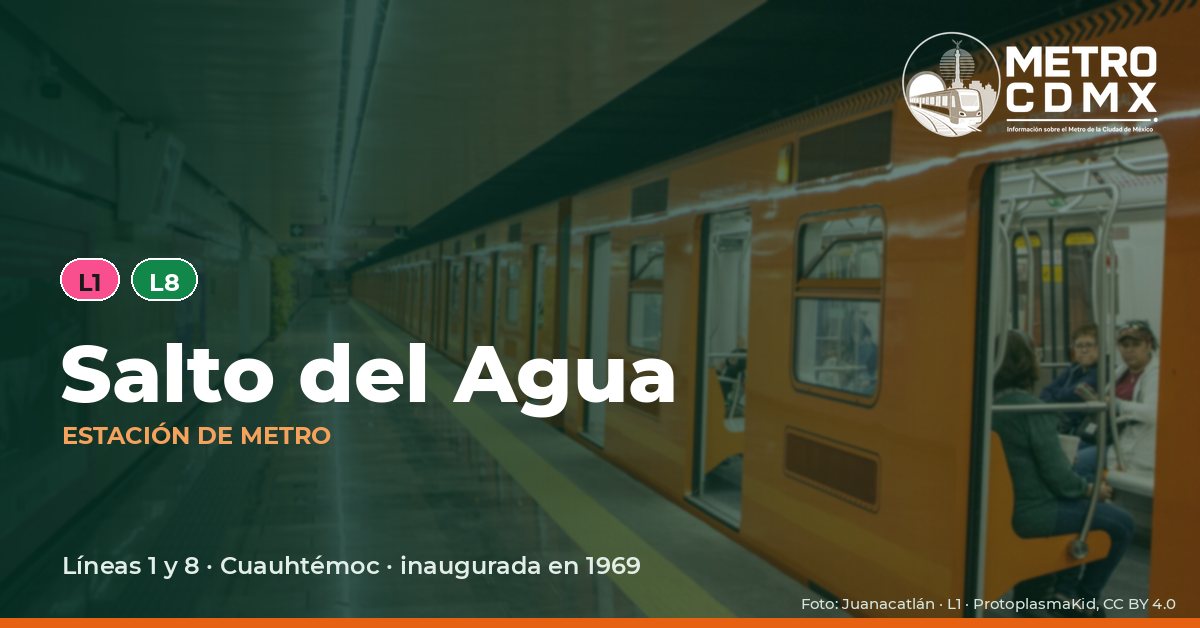
Salto del Agua metro station
Line 1 and Line 8 · Borough Cuauhtémoc
Salto del Agua station
The operator records Line 1 with no entries in January–March and April–June in 2024 (closed for works), so the annual figure does not cover a full year.
Line 1 opened here on September 4, 1969 and Line 8 arrived on July 20, 1994, making it an interchange. The name comes from the colonial fountain next door. According to the operator, on March 20, 1779, with Antonio de Bucareli y Ursúa as viceroy, a public fountain was opened where the arches of the aqueduct from Chapultepec came to an end, along what are now Avenida Arcos de Belén and Avenida Chapultepec; the name comes from the cascade the water made as it fell into a stone basin held up by three children riding dolphins.
The Line 1 station closed on July 9, 2022 for the rebuilding of that line and reopened on September 13, 2024, with the stretch from Isabel la CatólicaES to BalderasES. That is why, of the 6.0 million entries the operator recorded in 2024, only 858,711 belong to Line 1, closed for the first half of the year; Line 8 came to 5.2 million.
Service hours at Salto del Agua
| Day | Network service hours |
|---|---|
| Monday to Friday | 5:00 to 24:00 |
| Saturday | 6:00 to 24:00 |
| Sundays and public holidays | 7:00 to 24:00 |
These are the service hours the operator publishes for the whole network, the same at every station. It does not publish a first and last train time for each station: a train leaving a terminus at opening time takes a few minutes to reach the others, and service can change on special days.
How often trains run (estimate)
An estimate: it is the single headway the SEMOVI GTFS models for the whole line and the whole day (open data, valid until December 31, 2025). The operator does not publish headways by time of day; at peak and off-peak times the real interval changes.
Stations next to Salto del Agua
Approximate travel time between Salto del Agua and the stations either side of it.
| Line | Next station | Estimated time |
|---|---|---|
| L1 | BalderasES | 1.3 min |
| L1 | Isabel la CatólicaES | 1.1 min |
| L8 | San Juan de Letrán | 0.8 min |
| L8 | DoctoresES | 1.2 min |
Running time as modeled in the SEMOVI GTFS (open data, valid until December 31, 2025), not counting the wait or the time standing at the station. It is not a timetable figure from the operator.
Transfers and connections
- Metro: interchange between Line 1 and Line 8, inside the same station (the operator treats it as one station, with passageways between the platforms; it does not publish transfer times).
- Trolebús: Line A (zero-emission corridor Eje Central) running north to south and running south to north, on the Eje Central Lázaro Cárdenas.
Transfers to other systems as listed on the station page the operator publishes. The Metrobús, Trolebús, Tren Ligero and Tren Suburbano are paid for separately.
Accessibility
Four access ramps and escalators.
Station page, "Instalación para personas con discapacidad" section — the operator's own words
Services in the station
- Cultural display case
In the transfer passageway between Lines 1 and 8.
From the station page the operator publishes; opening times and locations can change.
Exits at Salto del Agua
The station exits and where they come out, as the operator describes them.
| Exit | Location |
|---|---|
| From Line 1, north | Avenida Arcos de Belén Norte, Colonia Centro. |
| From Line 1, south | Avenida Arcos de Belén Sur, Colonia Centro. |
| From Line 8, north-east | Eje Central Lázaro Cárdenas and Plaza de las Vizcainas, Colonia Centro. |
| From Line 8, north-west | Eje Central Lázaro Cárdenas and Delicias, Colonia Centro. |
The Salto del Agua icon
Every station on the Metro has an icon of its own. This is how the operator describes it:
The station icon is the Salto del Agua fountain, where the aqueduct from Chapultepec ended. On March 20, 1779, with Antonio de Bucareli y Ursúa as the new viceroy of New Spain, a fountain was opened where the arches of the aqueduct came to an end, running along what are now Avenida Arcos de Belén and Avenida Chapultepec. The name Salto del Agua — the water's leap — comes from the cascade made by the water falling into a stone basin held up by statues of three children riding dolphins. In those days people living nearby came to fill buckets, pots and jars. The fountain survives as a colonial jewel for its fine craftsmanship; its front carries a large relief of the arms of Mexico City as they were then used: an eagle with open wings and a cross on its breast, Spanish standards between its wings and war clubs hanging from its claws, with a medallion on its breast bearing the city's arms. That coat of arms was erased after independence was won, because it included prickly pear leaves with the imperial crown.
Official description of the icon — the operator's own words
The Metro icons are registered with INDAUTOR by their owner, which is why we do not reproduce them.
What's near Salto del Agua
You are on the southern edge of the old centre, where Arcos de Belén crosses the Eje Central. The Mercado San Juan is about 10 m away and the Plaza Vizcaínas about 150 m; about 320 m away is the Plaza de San Juan and about 370 m the Mercado de San Juan Ernesto Pugibet. The church of Nuestra Señora de Guadalupe El Buen Tono is about 340 m away. Trolebús line A runs along the Eje Central.
| Place | Straight-line distance | On foot (estimate) |
|---|---|---|
| Nuestra Señora de Guadalupe El Buen Tono | 340 m | 5 min |
| Mercado San Juan | 10 m | 1 min |
| Plaza Vizcaínas | 150 m | 2 min |
| Coppel | 150 m | 2 min |
| Plaza Vizcainas | 190 m | 3 min |
| Plaza de San Juan | 320 m | 5 min |
| Mercado de San Juan Ernesto Pugibet | 370 m | 6 min |
Places from OpenStreetMap within 400 m. The walking time is an estimate (straight-line distance × 1.3).
Frequently asked questions
According to the operator, from the public fountain opened on March 20, 1779 where the aqueduct from Chapultepec came to an end. The water fell in a cascade into a stone basin held up by three children riding dolphins, and that “leap” gave the place its name.
From July 9, 2022 to September 13, 2024, for the rebuilding of Line 1. The Line 8 platforms kept running, and in 2024 they accounted for most of the station’s entries.